Creative Writing + Short Stories
Peaceful Departure: Day in the Life of the Undead Taxi Cab
Florida, USA
January, 2026
It began with a scroll on Indeed. A nineteen-year-old Evan had just moved to Florida to begin his first year of college. Born and raised in Massachusetts, Evan had tired of the cold and was looking to bask in sunlight and live a stone’s throw from the coast. Like any student, Evan wanted to find a way to earn money on his own—the first step to true independence. One day, he came across a job posting that read: Mortuary Removal Technician. The position offered between $650 and $1,150 per week, and all you needed was a driver’s license. Unsure what to expect, Evan took a chance and applied. Soon, he found himself in an interview, then officially on the job.
If you are anything like me, or any kind of curious person, you are probably wondering what this job entails. And it is exactly what it sounds like. Evan is in charge of removing bodies. Dead bodies. From hospice, hospitals, morgues, and homes. Sometimes, even parking lots and hotels. Cyprus First Call is here for all your mortuary transport needs.
His shifts vary in time of day and duration. While also attending classes, doing homework, and studying like any other student, Evan is “on call.” While on call, Evan can go about his day—run errands, get lunch, take a walk. But when the phone rings, he must drop whatever he is doing, put on a black suit, and get into one of the three company-issued transport vans. The vans are like any other you’d see on the road—Toyotas and Hondas—but with the back seats taken out, leaving room for up to 2 bodies.
Each removal site is different. One can never be certain about what one might be about to see. Most of the time, the bodies are peaceful, slightly colder versions of their former selves. In these cases, Evan lifts them, wraps them in a sheet, then a well-made quilt, and then places their heads delicately on an embroidered pillow in the van. Evan explained, however, that the bodies are not always in the “best condition.” I immediately needed more information than that. Evan calls them “decomps.” These bodies, or what I would call corpses, had been left in their deceased state for a week or more before being found. Decomposition was in full swing, and the bodies had deteriorated greatly from their human form. On one of his worst days of work, Evan was met with a decomp whose skin was bubbling, scalp was falling off, and had been hosting a small family of maggots for quite some time. Despite the state of the body, Evan had a job to do. He must lift the body into a body bag for transport.
There are times when Evan is the only person on call. As part of a three-person company, Evan often moves bodies weighing up to 150lbs by himself. Above 150lbs, however, there is a secondary person on call to pitch in. They too have to wear a suit. No tie, however, because of the logistical implications of a hanging article of clothing: “We can’t have the tie falling into a body’s mouth,” says Evan. The suit, in Evan’s view, is a sign of respect towards both the deceased and the surviving family. Furthermore, Cyprus’s competitors, a larger company called Central Florida, wear t-shirts and beanies to retrieve bodies. Evan thinks this behavior is distasteful and makes the whole process appear akin to trash removal.
Cyprus also gets calls for pet removal, every so often. Evan’s favorite day at work was retrieving a pet rabbit, Pluto, from its family home. A boy, around Evan’s age, handed him a small pink bucket of ice as a vessel for transport. The boy unabashedly looked crestfallen at the loss of this beloved pet. Evan was deeply moved by the whole experience. “I take great pride in providing a service for people,” says Evan, “more so than just transport, I am also there to support the families and ensure their loved ones leave with dignity.”
Cyprus First Call was founded by Noah, now 20 years old. After working in “the industry” for several years, Noah decided to start his own mortuary transport company at just nineteen years old. Over the past year, they have accumulated clients through the network of funeral homes in their area. They don’t have contracts with these homes, but their business has spread fast through word of mouth. Just last month, Cyprus received between 200 and 300 calls. They are now training a fourth employee and renting office space.
Evan describes himself as “a chill person.” In his free time, he hangs out with friends, plays baseball, or ventures through the nature of New England when he returns home. He rarely sweats the small stuff and has adapted to the peculiar circumstances of his profession with ease. Evan loves his job. Much like most nineteen-year-olds, Evan has no idea what he wants to do with his life; however, he wishes to work in mortuary transport for as long as he can.
A Note About My Future in Production
January, 2026
Applying to Grad School
Once upon a time, three dragons visited my grandma's house, sort of a “Mama Bear, Papa Bear, and Baby Bear” lineup. They had all the regular ticks that dragons do: breathing fire at inappropriate times, landing on structures that don’t support their weight, and generally causing a ruckus. The peculiar part of this ordeal was that the dragons were actually loan sharks, looking to cash in on a deal. They trudged around my grandma’s secluded backyard, cupping their claws to peek in windows and smacking baseball bats on their scaled palms. During this time, I was swiftly transforming my grandmother’s screened-in porch into an office supply store and frantically selling printers, binders, and pens to pay off these loan-shark dragons. Suddenly, birds began to form a single-file line outside my supply store. Merchandise was flying off the shelves, literally, as the birds purchased reams of paper to augment their wings. Something about glide time? I wasn’t sure because of the language barrier. “Baby Bear” soon had enough and breathed a dark tendril of fiery smoke into what looked like letters, then words, then a sentence. I looked up and squinted at the now clear phrase etched into the darkened sky: “Time’s Up!” And then I jolted awake.
For most of my life, my conscious and my subconscious selves have been writing stories. My dream journal is full of tales of woe, heroes' journeys, and even some new animal species. Now, I realize my dreams were my first pull towards a career in production. Everything that inspires me is in the entertainment space: front row at a comedy show, on a train, manically typing sketch ideas, or holed up watching a favorite TV show for the fifth time. In a way, my life has been its own sitcom. Instead of a nuclear family, I had a kickass single mom; instead of consistent characters, I met a flock of absolute weirdos. From a near-decade working in a barn with some of the most terrifying people in the world (equestrians), to a life of being publicly bullied by grown adults (club volleyball coaches), I have built an unintended arsenal of stories.
Working in Washington, DC, for the past three years, I have listened to voters across the US—Salmon fishermen in Alaska, third-generation farmers in Iowa, deer hunters in upstate New York. I gathered these stories to simplify complex issues, such as how to restore Article I of the US Constitution, how to use data privacy to safeguard kids on social media, and how to limit the unchecked power of Big Tech giants. To make these stories resonate with a broader audience, I used the power of media production. I wrote scripts for candidates’ campaign ads, filmed informational videos for political non-profits, and photographed Big Tech CEOs floundering at congressional hearings.
Much like in my dreams, I was inadvertently acquiring the skills of a producer. I learned about the importance of collaboration in the campaign world, of making deadlines in the non-profit world, and of succinctly pitching policy changes to elected officials on Capitol Hill. My favorite weather is a brainstorm, if you will. Unfortunately, politics can be a world full of metaphorical umbrellas. In sum, despite my persistent attempts to activate my creative passions in my career, it became clear that I belonged somewhere else.
Royal Holloway’s Master's in Producing Film and Television is built to empower students like me—people with untapped imaginations who just need the tools to bring their stories to life. I am drawn to the way this MA offers comprehensive production practice. The leadership of your program is astounding. Sheryl Crowne, Linda James, and David Thomspon are a stacked team with an exquisite range of experience. The program boasts a fleet of guest speakers from across the entertainment sphere with their own range of achievements, from Emmys to Golden Globes to Oscars to published novels.
With the guidance of Royal Holloway's thriving creative community, its teaching team of industry experts, and comprehensive curriculum, I will absorb everything that goes into a production and what the current industry needs from producers. My ultimate goal is to write, produce, and perform in an animated comedy show akin to Bob’s Burgers or Big Mouth. Your program will give me the skills and confidence—not only in myself as a producer, but also as a writer and editor—to turn my teeming dream journal, overflowing notes app, and now storage-scarce camera into something greater than my imagination.
Where Have You Been All Day?
May, 2022
Copenhagen, Denmark
I walk an average of five miles a day. These walks are nothing short of sacred to me; my phone rests silently in my pocket, and I listen only to the air. Copenhagen is a city for walking. The city is known for its bikers, and I respect them, but I find that a city can be known most intimately on foot. The streets stretch far and each turn reveals a new architectural personality. Colors shift from yellow to blue to gray as I walk through the neighborhoods. Norrebro has spunk and grit, while Fredericksburg has a clean and polished feel. I duck into alleyways and meander around the harbor with a curiosity that two wheels would hinder.
At home, I was embarrassed to walk alone. I would walk fast, on a runway of my own creation, to seem cool and mysterious, rather than lonely. Even just when walking, I was tailoring my existence to external perception. That was then. Here I walk as if I am invisible. I float through the streets like a gentle gust of wind --- not looking to be seen, but to see. This has helped me notice things that I would have normally sauntered past.
On one of my walks, I stumbled upon a small cafe. Nestled between two banal white buildings, it boasted a burst of yellow paint and black window trimming. In Copenhagen, I have grown accustomed to such pops of color, but this yellow cafe was so confidently bright that I felt I had to enter. Walking solo allows for these sporadic changes in route.
I used to hate being alone. The silence always seemed deafening; making spaces meaningless without some sort of chatter. I blamed it on my extroversion. Talking gave me energy and moments seemed more special when shared. Conversation has always come easily to me, and being around people made me feel valuable. I came to Copenhagen alone. It is my final semester of college, and most of my peers are meandering through their normal routines at my school. When I shared the news I was traveling abroad, I received a torrent of raised eyebrows and tilted heads.
“But it’s your senior year” they would say. “Don't you want to be with the people who know you?”
Though I would brush it off and tell them I was excited, there was a small sprout of nerves in my chest that bloomed as time moved on. I had many fears about traveling abroad, mainly that I was going to be alone. My extroverted tendencies had waned over my college years, along with my confidence in making connections.
After engaging in a persistent cycle of love and heartbreak during my college experience, I had not let myself be completely alone. When I would witness something great, I would instinctively share this moment with my significant other. It was as if my life was only meaningful under the gaze of someone else.
I left my close friends behind when I arrived in Denmark. Just a week prior, I ended my relationship, as an act of self-love. I was on a quest for true independence.
The inside of the cafe was cramped --- but in a comfortable way. The window sills were lined with lit candles and small succulents. It reminded me of the small plants I would often neglect in my college dorm room. On walls hung eclectic art pieces: framed collages, and small sculptures. In one corner, there was a glass case displaying three different fedoras. Strange. I thought. Throughout the room, there were mirrors of different shapes and sizes, catching different pieces of my reflection. I only glanced at them briefly.
There was a boy working behind the counter. He subtly nodded his head to the song playing through the tiny speaker on the windowsill as he cleaned the espresso machine. Sex on Fire by Kings of Leon was blasting with a tinny crackle. Immediately, I noticed his overalls. They were bright red with white vertical stripes. Where’s Waldo? I thought to myself. His back was turned to me. I started to get the feeling that I was about to scare the crap out of this poor employee. I cleared my throat. The head bobbing continued without a flinch. I noticed a small silver bell on the counter and, after much deliberation, tapped it once with a wince.
During my solo walks, I always become shy. I find that being alone with myself often causes me to retreat inward, at times rendering me incapable of social interaction.
Ding. What a cute little sound. The boy’s shoulders shuddered swiftly and I swear I heard him let out a small yelp. He definitely did not hear me come in. I chuckled to myself. I really am the wind. He turned around and met my gaze. His eyes were as complicated as his overalls, with flecks of green and blue; like lily pads on a still pond. A toothy smile spread on his face.
“You startled me! I am sorry I didn’t see you there.” He says with a slightly raspy chuckle. I smile back at him.
“I love this song,” I say, noticing that I started bobbing my head too. “I have to say that I have never heard it played in a Danish cafe.”
“That makes sense, the Danes don’t appreciate good music!”
“Ouch! You must not be Danish then, or you are just extremely cynical.” I say, not used to critiques of Danish culture. “What is your name?”
“Rasmus”
“Oh, you’re definitely Danish.”
“Guilty!”
My eyes scanned the space. I noticed a narrow yellow wooden staircase leading upstairs. Small potted ferns were placed on each step.
“What’s up there?” I ask.
“More seating, if you’d like a little view. What is your name then?”
“Willa.”
“I’ve never heard that one before. Are you German?”
“Do I sound German?” I say with thick sarcasm.
“Touchée!” He giggles.
I ordered a dirty chai latte --- a chai with a little oomph--- and ascended the rickety staircase. Each step groaned and squeaked under my Converse. It reminded me of my staircase at home that kept me from ever sneaking out. This cafe had so many little pockets of home: the tarnished gold mirrors, the strange art, the pale yellow walls. When I was seven, my mom and I spent three days painting my room yellow. The paint spilled everywhere and we ended up being covered in subtle yellow splotches. I breathed a sigh of nostalgia.
Being here alone made this cafe feel entirely mine. The succulents, the creaking stairs, and the friendly Waldo-Esque barista were all special only to me. The inner dialogue in my brain would only make me laugh, thus sharing it with someone else would only damper the experience. Is this what it’s like to be introverted? I had always defined myself as an extrovert, practically since birth. But can extroverts ever be happy alone?
I considered this as I settled into my seat. The upstairs of the cafe was more open, but the hygge initiatives continued. Hygge, for those who are not entrenched in Danish culture, translates to "the art of cozy," or in layman's terms, putting soft lighting wherever possible. Despite a fire hazard.
There were plants everywhere upstairs. Long leaves of spider plants, thick cacti, and vines intertwined and curtained the space. The entire room had a yellow glow. It was overcast outside, and a weak natural light hobbled through the windows. Candles dripping with wax sat on each table in tarnished gold holders. The space sported a marriage of modern New York City chic and medieval Viking opulence. It reminded me of the painfully mismatched furniture in my living room. I loved the awkwardness of it. I sat near the window and took in the quiet side street. Copenhagen can at once feel like a thriving metropolis and a suburban neighborhood. This street resembled the tranquil slow-paced nature of my hometown. People walked slowly. I saw a dog off its leash gleefully sniffing, then eating, a discarded hot dog. The city seemed far away.
The stairs begin to sing as Rasmus bounds up the stairs with my drink.
“You know how I know you’re American?” He says. I can sense the coy comment brewing through the flicker of his blue eyes. I lean back and cross my arms over my chest, looking at him with exaggerated curiosity.
“This is the first time I have ever had to make a dirty chai.” He chuckles at himself. I always appreciate people who laugh at their own jokes. I look down at possibly the most beautiful latte art I have ever seen. Rasmus notices my shock and smiles.
“What, do they not have pretty coffees in America?” Another chuckle. Waldo really cracks himself up.
“I suppose we need to up our game!” I say with a smirk. “Are you an artist?”
“Oh come on, it’s not that good. But yes I am an artist!” His eyes glitter as he notices the word artist piquing my curiosity.
“Let me guess… music?” It's a shot in the dark, but based on the overalls, this man’s confidence has to come from somewhere. Has my inner monologue become rude?
“Guitar,” Rasmus responds. He begins miming a ferocious guitar solo. This dude is nutty.
We spoke about his extensive musical experience in Copenhagen. He has his own band that he insists is going to blow up any day now. He has been playing the electric and acoustic guitar for 12 years and has never ceased to love the instrument. I had never been so fascinated by a stranger. He had the cadence of a young child, but the certainty of an old man. He insisted he knew guitar better than anyone in the world, and for a moment, I believed him.
“I practice 6 hours a day sometimes.” He tells me. He crosses his arms and nods like he was overcome with pride just talking about his dedication.
“Do you ever get tired?” I say, genuinely curious.
“Practicing for me is like resting. I feel so at peace---as if I am asleep. Maybe that’s why people say they can do things in their sleep. Ha! I get home from work and what I need to unwind is not TV or my phone, I just need my strings.”
I considered this. I couldn’t imagine feeling so comfortable in a talent. I suppose that is what happens when you find your purpose.
I smiled the entire walk home, not caring that I probably looked a little creepy. The tall, thin, colorful buildings guided me as I walked. The wind pinched my nose and ears and swirled my hair in its chilly fingers. Despite the bone-numbing chill of Copenhagen March, I walked slowly. If it had been a few months ago, I would have rushed home to tell someone about this peculiar person I had met. I would have told the story quickly and excitedly, awaiting their reaction and input. I would be intentional about my wording, to make them laugh or pique their curiosity. My life always needed to appear interesting to others. That day, I didn’t care. I was alone the entire day and hardly noticed. My interaction with Rasmus was entirely my own, and I felt no urge to share it.
I returned home and my roommate was quietly doing her work at our shared desk. The soft hum of the tea kettle made me feel warmer somehow.
“Where have you been all day?” She asks.
“I just went for a walk on my own.”
First Week Encounter
Blue Bike Cafe
Indre By, Copenhagen DK
Yesterday, I learned that a cafe can also be an architecture studio. Studios are known for their coolness and sharp edges. Cafes are warm and soft. How could these antithetical spaces coalesce?
“I turned my studio into a cafe to meet more people.”
Nico smiles as he shares this. His cafe, the Blue Bike Cafe, opened six years ago. His studio had resided there since 1987. Nico’s company, Nicodesign, hosts architecture interns and students from around the world.
“Can I have a latte?” I came here on a caffeine mission. There is something about Nico that I find comforting. He is a small man, about 5’4”, wearing an apron covered in floral print. His grin is effortless, as if he is always fighting the urge to smile. His words are wrapped in a thick Greek accent. Coated in sarcasm, his voice drips and flows like molasses.
He places my latte on a detailed ceramic plate with a small ginger biscuit. Those are complementary. I sense that he takes great pride in both his food and designs.
“Take those coffees one at a time,” He says with a chuckle. “I have seen too many lovely things hit this floor.” He laughs again. “It’s not that I don’t trust you—well, maybe I don’t—but people always seem so confident, ‘oh, look at me with two coffees’ and then boom! On the floor.”
He gives me a wink and a thumbs-up. Board games are stacked near the walls, and the lit candles drip with wax. One lone bike hangs from the ceiling. On the walls, there are several floor plans and designs: bikes, buildings, yurts, homes, all meticulously crafted.
“Those are all mine! Yes, those come from me. Some of these designs exist in the world already!” Again, I hear the pride in his voice. His accomplishments seem to brighten him. Nico speaks with his hands as if words aren’t enough to convey his passion. He says his two sons are the light of his world.
“My oldest son, you know, he is 35, yes? And you know what he does? He buys everything through exchange, yes. The young people here, like you, they all exchange clothes, no more wasted things, better for the environment, you know?”
He draws a map with his pointer figure in the air, directing us to his favorite thrift store. My housemate frantically scribbles down the name. To us, Nico’s suggestions are tinted gold. Before we left, Nico insisted we return with our families.
“I love to see where you come from. Family is where you come from.”
Nature: Iceland Reveres Her.
Our bus was rocking with an uncomfortable fervor. I am used to buses being a sturdy mode of transportation; now it feels like I am sitting in a hamster ball. In Iceland, storms come quickly. Sunlight can pour over the lush landscape for hours, but in a matter of minutes, dark gray clouds will corrupt the sky: rock, squeak, creak, rock. The bus groaned with each 40-mph gust. We were far from Reykjavik, or any civilization for that matter, and I was preparing for disaster.
Taking 40 high school students on a trip to Iceland cannot occur without hiccups. Our entire trip has taken place on our trusty steed: a long, bright green, and creaky bus. We are all here to expand our knowledge of the natural world. Iceland is home to some of the most captivating glacial features in the world. The small country is situated on the very active Mid-Atlantic Ridge in the North Atlantic. Black sand beaches, glaciers, and volcanic rock are just a few of its breathtaking natural features. Iceland is a fleeting natural wonder. That is what makes it truly special. The glaciers recede by the day, and sea levels continue to rise. Climate change has a strong and suffocating hold on Iceland’s unique landscape. Knowing that I may never witness Iceland the same way again, I was focused on creating the strongest memories I could. I wished to make Iceland immortal in my head.
This was one of the moments that will become an infinite memory. The bus was nearly toppling off the narrow road. To my left, there was an impressive mountain range looming above us. Above the mountains was a swirl of dark blue and gray sky that penetrated the sunlight like black ink on canvas. The clouds were moving swiftly. The wind whistled through the bus, shaking the windows with ferocity. The bus suddenly began to tip, and I looked out the window to see that we were driving right off the road. I scanned the bus and saw faces as horrified as mine.
Yeah, we’re gonna die.
The bus ground to a halt–the tires skidding in protest on the gravel. Our bus driver, Ingólfur, popped up from his seat with an eerie calmness.
“Ok, folks! Everybody off!” He said cheerily.
We all looked at each other, then at the curtain of darkness stretching over the sky, coming right towards us, and then at Ingólfur. He seemed confused by our hesitation to leave our shelter and gestured towards the door. Slowly, we began to shift in our seats, then apprehensively rose and began to follow Ingólfur out into the abyss.
The wind was so overpowering, I had to focus on keeping my feet on the ground. I had never before felt so overcome by nature's strength. It was as if the Earth was reminding us what she could do—most certainly a threat. 40 high school students, two teachers, the bus driver, and our tour guide now stood on the side of a desolate highway. The wind was roaring in my ears. Darkness curled and blossomed in the sky like black tulips. There didn’t seem to be a plan, but Ingólfer was walking down the road with purpose. We followed. Though it was hard to see through the debris flying in my line of sight, there seemed to be a small building in the distance. Ingólfur and Arnbjörg, our tour guide, seemed to be headed there.
Icelandic people don’t sweat the small stuff. Storms of this nature are common in the summer months, and Icelandic people are privy to the strength of Mother Nature. They respect her. The difference between the group of 40 sheepish high school students and Ingólfer and Arnbjörg was simple: Icelanders revere nature while Americans exploit it. Our bus driver was enamored with the storm that was raging above us.
“Look at her power!” Ingólfer said, grinning. It was as if he trusted nature like a friend. Despite her power, he knew that she would protect us.
We were nearing the building. Out front, a small playground came into view, accompanied by a colorful sign that I could not read. The school grounds were quiet amidst the drama of the storm. It seemed to have been unoccupied for some time. The swings are caked with brown rust, and the sandbox is freckled with moss and debris. Arnbjörg headed for the door, which, miraculously, was unlocked.
As the building shuddered and whistled, we were huddled in a small auditorium with a few sleeping bags and wadded-up clothes. The storm was not letting up, and there were rumors that we were staying the night at this abandoned–seemingly haunted–elementary school. Morale was low. This was certainly not part of the itinerary, and we had a long journey ahead.
I think Arnbjörg could sense our unease. She had a way with people. A peculiar softness about her. She wore her pale blonde hair in a long braid down her back. Her eyes were impossibly blue–her own small glaciers, icy and captivating. She was the type of person you felt safe around, despite only knowing her for 48 hours. Next to her was a large rectangular bag. I noticed she was setting up a small stand of some kind and was unzipping the bag. It seemed that I was the only one who noticed the massive golden gong she was pulling out of the bag.
The room was buzzing with jitters and scattered conversation. Pockets of us spread out in the auditorium–some sitting, some standing, some pacing. I looked back at Arnbjörg. She was now grasping a small mallet with a soft tip and was tracing a circular motion on the gong. It was quiet at first–a dull hum. The initial vibration clashed with the bustle of the auditorium. Then, louder, the hum became a thick vibration. The chatter quieted. ZZZZMMMM. It was unlike anything I had ever heard. The vibration was electric: spreading across the floor and into my fingertips. I surveyed the room again and realized it had fallen silent. People’s eyes were closed, and no one was standing now. I felt hypnotized by the vibrations of the gong. My ear lobes tingled. I closed my eyes and the room fell away. The storm felt miles in the distance. All I could think or feel was the full, encompassing timbre of the gong. I don’t remember falling asleep. I woke to the sun pouring into the auditorium– it was 8 am. We slept for 12 hours.
Teenagers are supposed to thrive in structured environments. I think the world expects young adults to grow within these lines and boxes. I find that the moments of development occur off the beaten path. I would have never expected to be stranded in an Icelandic elementary school’s auditorium waiting out a storm and drifting to sleep being serenaded by an ancient gong. That is precisely what made this moment beautiful. Iceland had given us the gift of forced spontaneity.
Not a Local…
Botanical Gardens, Madrid.
I wanted a book. Reading while traveling is a very curious act—why would you want to transport your mind elsewhere when your body is already someplace new? I suppose while standing amidst the bustling side streets of Madrid, I was craving some routine.
The sun was at its peak in the sky–tucked in a blanket of brilliant blue. My sun-starved skin tingled with the unfamiliar warmth. It was only 66 degrees, but it felt like paradise. The entrance to the botanical gardens was a tall, gilded archway that boasted a sense of royalty. We were headed there to do what every other Madrid resident seemed to be doing: cure our seasonal depression. Hundreds of people were sprawled out on blankets, laughing and basking.
Then something even more beautiful caught my eye. Lining the entrance to the gardens were tables stacked with towers of books. We had just come from a flea market—not an experience for the faint of heart—where sellers would dangle jewelry in your eye line and yell ¡Dos euros! ¡Pero para ti, un euro! (Two euros! But for you, one euro!) That always made me feel special. The book market did not sport the same chaos. Sellers sat patiently at their stands–some of them were engrossed in books of their own. I dragged my fingers across the covers. Some were so worn I could barely make out the titles. Evidence of previous enjoyment. The majority of books were in Spanish, but I soon came across a title I recognized: The Outsiders. Thankful to see a book in English, I picked it up and brought it over to the seller. The man seemed quite elderly, with frosty white hair and an impressively coiffed mustache. The sign read “Libros 1 Euro.” I reached into my pocket and placed a coin in the man’s calloused palm. He looked at the coin, then up at me, then back at the coin.
“¿Qué es esto?” He says, with a growing look of confusion. I match his expression.
“No hablo español,” I say with a weak smile. I always feel like a tourist when I say that.
“What is this?” His accent is thick. Spanish to me sounds like honey and gravel, and a Spanish accent makes English sound far more beautiful than it is.
“Huh?” I say, following his gaze back to his palm. I see that he is holding a 10-cent coin. I’m an idiot. I reached into my pocket and realized I had only two 10-euro coins left, so I couldn’t afford this 1-euro book. I look back at the man, who now has an evident smirk on his face.
“You from America?” He chuckles. I bow my head in embarrassment.
“Yes, how did you know?” I am laughing now, my cheeks pink.
“You are from America, and you are poor?”
—
Flea Market, Madrid
After a pleasant morning of cheap cappuccinos and croissants, we were peacefully meandering through the colorful streets of Madrid. The city is alive, humming with energy as if fueled by the rising sun. The humming soon rises to a roar as we turn a corner and stumble upon one of the largest flea markets I have ever seen. The city center is exploding with life as people weave through rows and rows of market stands. Colorful clothes hang from clotheslines, picnic tables are stacked three feet high with clothes, and boxes of jewelry sparkle in the sunlight. There seems to be every imaginable kind of textile. From plates to scarves, to chairs, to shoes, someone could leave this market with a full wardrobe and furnishings for an entire home.
We split up to cover as much ground as possible. I immediately go to the racks of pastel dresses that flutter in the breeze. Beside the racks is a small table with what appeared to be hundreds of articles of clothing. I dig through the pile of fabric, essentially giddy with joy (everything is 1 euro!) A glint of pale green catches my eye. My favorite color. I tug at the corner of the fabric and pull forward the most stunning dress I have ever seen. It's mid-length, tapered at the waist, with 1950s-style piping around the frame. It was love at first sight. My smile wavered. I didn’t bring any cash with me. My heart sank. Surely this dress will be swept up at a moment’s notice. I was around a 10-minute walk from our Airbnb. I could make it. I lifted a pound of the clothing from the table and shoved the dress underneath to conceal it. I hustled home, not taking a moment to look around, despite the beauty I was passing. I was on a mission. I returned in what felt like hours but was only 8 minutes. Immediately, I ran to the sea of fabric that housed my perfect gown. It was gone. I tore through the fabric, looking under the table, around the market, through the hangers. Nothing. I let out an exasperated sigh. I felt like I was mourning.
Caught up in my sadness, I did not hear the voice trying to get my attention.
“¿Señora? ¿Estás buscando esto?” I look up to see the woman working the stand looking at me. She had a brilliant smile that stretched from ear to ear. She was wearing a purple bandana and matching purple glasses. Her shirt was blowing in the wind and had tiny lavender flowers. I appreciated the coordination. In her small hand, she’s holding the dress.
“¿Estás buscando esto?” She says again, noticing my stunned expression. She hands me the dress. She had seen me attempting to hide it and set it aside for me. I was so overwhelmed by this act of kindness that tears pooled in my eyes. I blinked them away.
“Gracias! Gracias!” That's all I can say. My excitement transcended our language barrier. So did her kindness.
What is a Woman?
Still Life
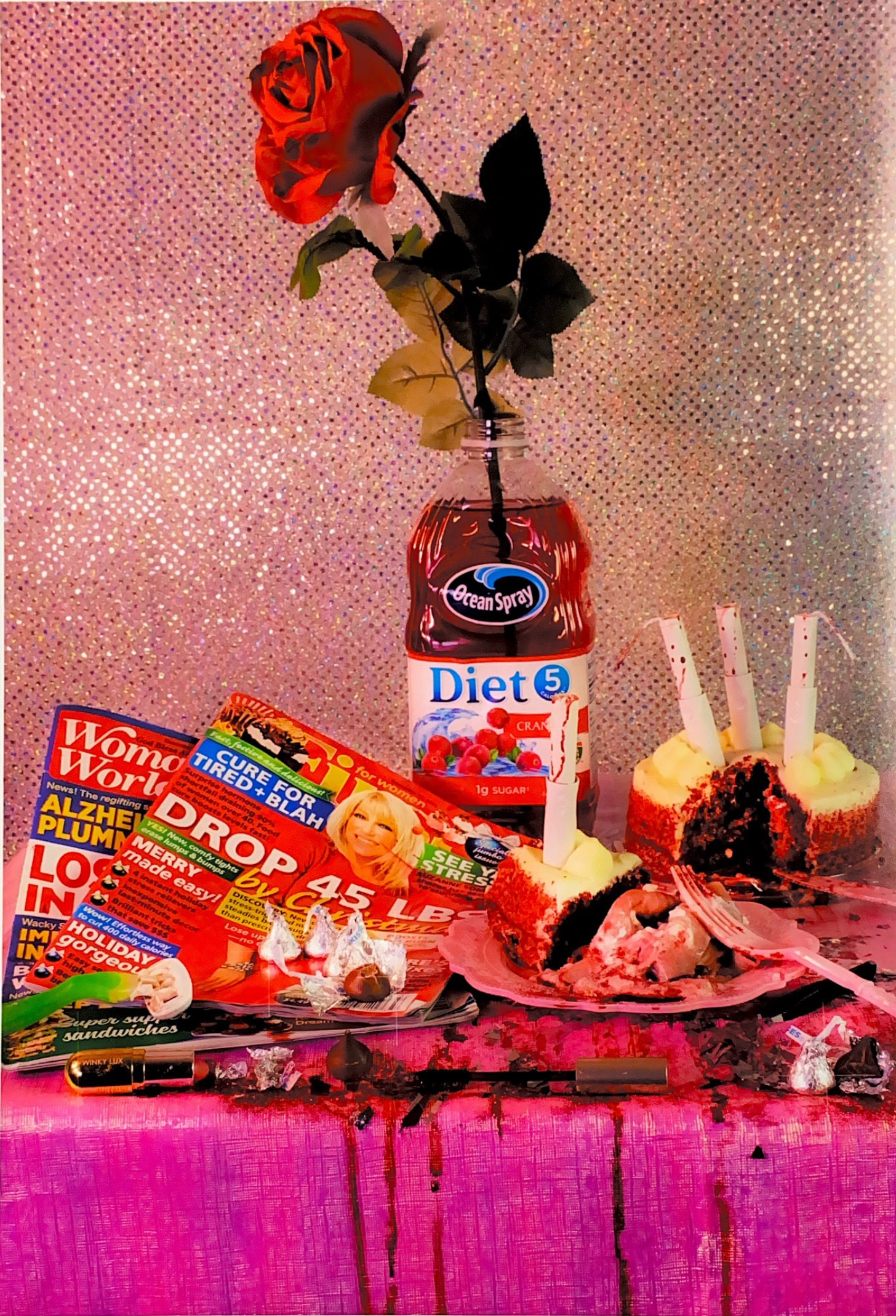
What is a woman? What do you see when you think of one? Are there pomp and frills? Do you see pink? Where does your mind go first? In my still life, I seek to coalesce preconceived notions of womanhood with the grotesque and confusing reality of being a “woman.” Womanhood is essentially contrived. The cosmetic sparkle of femininity isn’t natural; it’s created. In my piece, I include the commercialization of womanhood in my piece as a contrast to true womanhood. Mascara, lipstick, perfume, razors. All tools to create “beauty” rather than embracing one’s natural essence. The beauty of the “women” should include every part. Blood and goop, savory and sweet. Perfection is cast upon women as a necessity. In reality, the blood and gore of womanhood is, to me, the female body working perfectly. The female body is powerful and intelligent. The shock value of my image is exactly the problem. Being shocked by “imperfect” femininity is proof that our society places perfection above humanity. I reject the idea of flaws entirely. My piece seeks to contrast expectation with reality. The cake with tampon candles, a celebration of menstruation, a contrast to society’s condemnation of women’s blood. The magazines: “lose 40 lbs before Christmas,” unopened, placed next to a diet cranberry juice, but also on the same table as a beautiful red velvet cake, and chocolate candy. Expectations and reality. The essence of the true female body is evident on the plate, with mysterious meat and gooey substances.